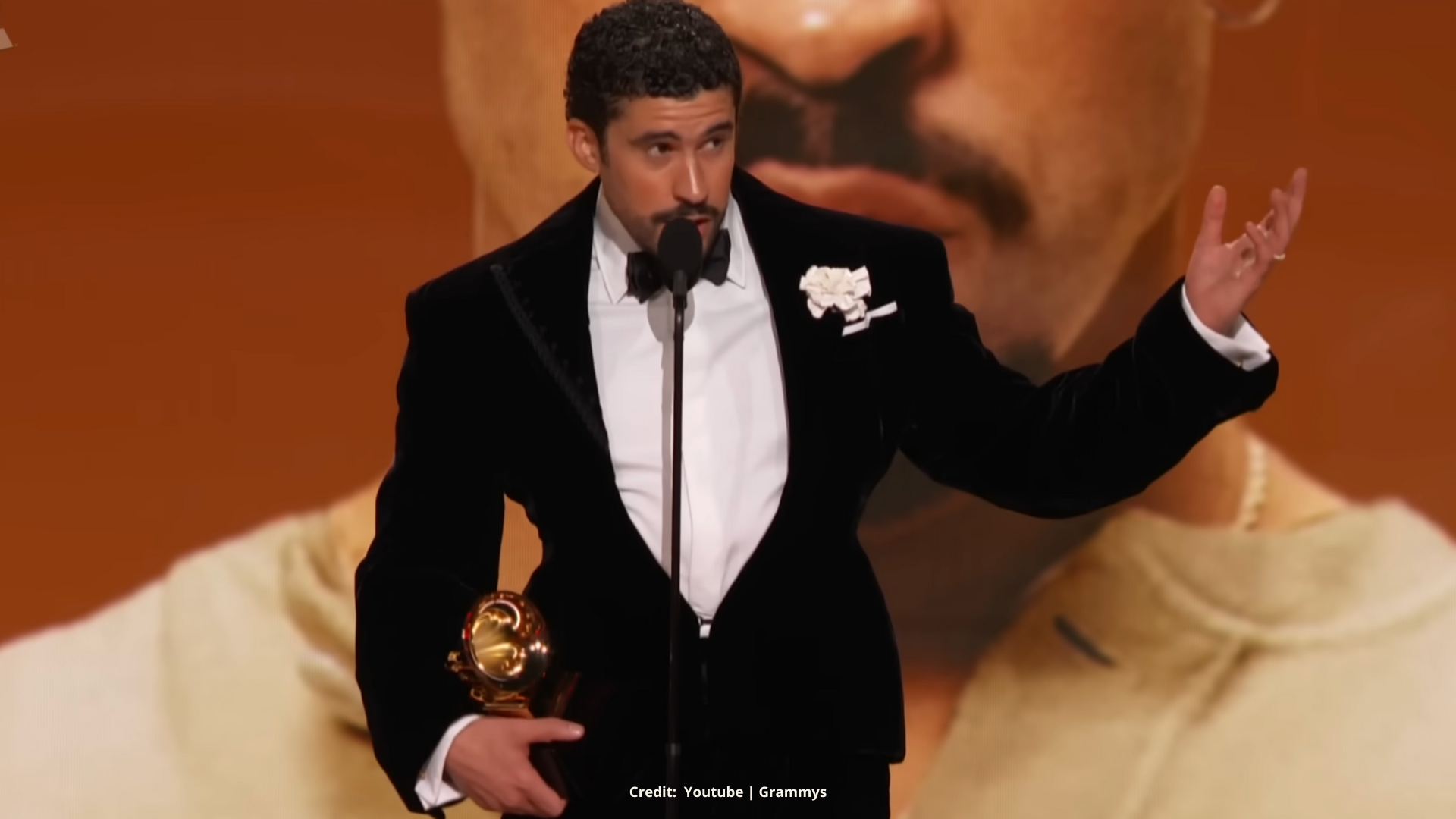
When news hit that Bad Bunny would perform at the 2026 Super Bowl LX Apple Music Halftime Show, many of us screamed collectively. For once, the biggest stage in American pop culture would belong unapologetically to a Puerto Rican artist performing entirely in Spanish.
However, in the culture war era we live in, where differences of opinion play out in real-time, it didn’t take long for nuestro orgullo to collide with extreme backlash from the conservative pundits.
Within hours, commentators from every corner of the online world had serious opinions. Conservative YouTuber Benny Johnson wrote on X that “the NFL is self-destructing year after year.”
Homeland Security head Kristi Noem promised that the United States Immigration and Customs Enforcement (ICE) “would be all over the Super Bowl.” President Donald Trump called the selection “absolutely ridiculous.” Conservative pundit Tomi Lahren complained that Bad Bunny is “not an American artist.”
Across the board, conservatives echoed the same concerns. He is “too political.” His gender expression is “inappropriate.” He will not sing in English; he will sing in Spanish. In addition to criticisms from public figures, there were even widespread calls among MAGA influencers to deport the performer.
By mid-October, a Change.org petition had been created. It requested that the NFL replace Bad Bunny with country singer George Strait as halftime show performer. Currently, over 112,000 signatures have been collected, claiming that Bad Bunny’s artistry “does not reflect American values.”
As a U.S. citizen, if Bad Bunny doesn’t reflect American values, who does?
U.S. Hispanics and Latinos have been woven into the very fabric of this nation’s story. We are the business owners fueling Main Street, the builders who reshape skylines, the dreamers turning struggle into innovation. They are creators and culture-shapers. Latino’s fingerprints can be found on everything from pop music and hip hop to the flavors at your favorite restaurant.
Our story is one of reinvention. Generation after generation, we have built bridges between languages, identities, and worlds. We have proven that “being American” has never belonged to just one face, one accent, or one way of speaking.
However, even with the aforementioned, we know what’s going on — the Spanish language still makes people so uncomfortable.

Time to grab the popcorn, because we’ve seen this before
The Bad Bunny Super Bowl LX novela, though, feels oddly familiar to me. I get a sense of pride mixed con déjà vu. In 2020, Jennifer Lopez and Shakira’s halftime show became an instant cultural milestone.
Two Latina superstars graced the stage and brought bilingual music to the masses. They danced to reggaeton rhythms, performed Mapale, an Afro-Colombian dance known for its rapid movements, and Champeta, a genre with African roots from Colombia’s Atlantic coast.
But instead of universal praise, they faced criticisms. After their performance, over 1,300 complaints were sent to the Federal Communications Commission (FCC) about Shakira and J.Lo’s halftime show. The show was considered “too political” and “too provocative.”
Lopez’s daughter, Emme Muñiz, sang “Born in the U.S.A.” inside a cage. A symbolic nod to the migrant children separated at the border. For many viewers, it was a moment of visibility; for others, it was “too much.”
The message for us is clear: you can be Hispanic and Latino, but not too loud and not too proud.
Why? Because the mainstream can only tolerate Hispanics and Latinos on Taco Tuesday with a side of sour cream. Everytime Hispanic and Latino artists bring their whole selves — language, culture, rhythm, and accent — to an American stage, the question becomes not “is it good?” but “is it palatable?”

The endless code-switching is tiresome
For decades, U.S. Hispanic and Latino performers were told that success meant assimilation. Speak English. Change your name. Lose the accent. It’s alleged that entertainment executives have told up-and-coming Spanish-speaking artists that “we need to have Beth from (insert any Midwest state here) like your music and style.”
Bruno Mars? Born Peter Gene Hernandez. Oscar Isaac? Born Óscar Isaac Hernández Estrada. Psych actor James Roday? He is Mexican-American on his dad’s side and was born James David Rodriguez.
From Ricky Martin to Selena Quintanilla-Pérez to Gloria Estefan to Shakira, artists have tiptoed that fine line to become a U.S. crossover artist. It’s all been in an effort to make U.S. audiences comfortable with our sound, our bodies, and our language.
But then came Benito Antonio Martínez Ocasio. He never code-switched. He never apologized for being fully Boricua. His lyrics are colloquial, raw, hyperlocal, and yet his reach is global.
Fans from Tokyo to Toronto sing in Spanish because they want to, not because they understand every word.
In fact, non-Spanish speaking Bad Bunny fans are learning Spanish to sing along with his Apple Music Halftime Show performance. He’s proof that authenticity is the new universal language.
Spanish Language Still Feels “Less Than”
So why does the Spanish language still make people uneasy on American stages? Because language in the U.S. has never just been about communication — it’s about power. In classrooms across the country, generations of Latino children were scolded, suspended, or even struck for speaking their native tongue.
By the 1950s, “English Only” rules had spread across schools from Texas to California. With them came the kind of shame that lingers long after graduation. I remember being told to “speak English” as a kid by my mom to impress others around me. The phrase snapping like a whip in the air, reminding me of my place. We couldn’t risk being marked as “other.”

On television and in film, Hispanic and Latino accents have frequently been stereotyped, used for comedic effect, or marginalized. Spanish wasn’t just treated as “foreign;” it was treated as a flaw. A language for the people who help, not the leaders in the boardroom making all the decisions.
Today, approximately 43 million people in the U.S. speak Spanish as their primary language. This represents roughly 14% of the entire population. If we include those who speak Spanish as their second language, then the U.S. is the second-largest Spanish-speaking country. Mexico, to the south, being the largest.
The NFL is rising up to meet the cultural moment
Let’s talk some truth. The NFL didn’t choose Bad Bunny by accident. This was pure strategy. After years of criticism for its lack of inclusion, the league has made deliberate efforts to change its image.
There is no bigger global superstar today than Bad Bunny. He is a Puerto Rican artist who outsells English-speaking pop icons and headlines Coachella. His recent album has brought the beauty of Salsa to a younger generation. His sold out residency boosted the Puerto Rican economy. He has accomplished all of this while filling stadiums worldwide and never compromising his identity.
The NFL made a business decision that’s also a cultural acknowledgment: the Latino market isn’t niche anymore.
NFL Commissioner Roger Goodell has rejected calls to replace Bad Bunny as the halftime show performer. He has affirmed that “no one is being removed from the performance’s lineup.”
During a press conference, he told reporters, “He’s one of the most popular entertainers in the world… I have full confidence it’ll be a good show.”
Benito reminds us that we need to say “yes” to ourselves more often
Bad Bunny’s decision to headline isn’t political theater. During a Saturday Night Live appearance, he made it clear where he stands.
He said it plainly, “More than my accomplishment, it’s an accomplishment of all of us — demonstrating that our mark and our input in this country cannot be thrown out or erased.”
He is right. Representation is not about perfection, it’s about presence. We come from 20+ countries, speak in accents shaped by oceans and borders, and carry stories that don’t always fit neatly into one flag.
What keeps us together is that we share a rhythm. When that rhythm plays on the world’s biggest stage in February 2026, it deserves to be heard in its original tongue. In his words, folks now have four months to learn Spanish so that they can keep up.